
This article was created with the AI assistant Claude and published by Peter Hoenig.
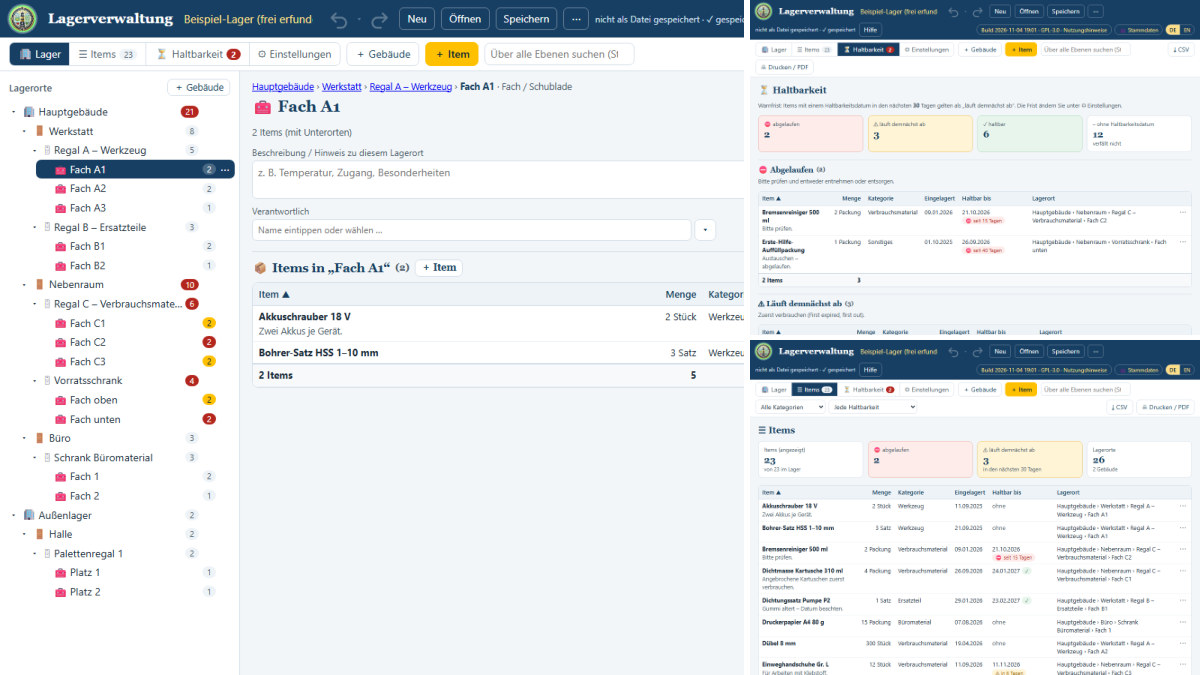
“Have we still got that?” – in a small business this question costs time every single day. Someone looks into two shelves, asks a colleague, and in the end orders a new one anyway. Weeks later the pack turns up at the back of a compartment, past its date. Large inventory systems solve this, but they are overkill for a store room with five shelves. That is why my tools now include warehouse management built the way your store actually looks – and you can use it from your phone while standing in front of the shelf.
At a glance
- Six levels as in real life: buildings › rooms › shelves › compartments and drawers › containers › items.
- Containers for boxes and crates: freely movable like items, and they may hold further containers.
- Choose your own colours and type: background colour, text colour, typeface and text size – per level and per individual object.
- Nothing is lost silently: deleting a storage location that still holds something prompts a question – move the contents or delete them too.
- Date stored and best-before date for every item, plus a warning list with a period you set yourself (30 days by default).
- Search across all levels by item, category, supplier, batch or storage location; withdrawals and additions stay with the item as a history.
- On your own or as a team: as a single HTML file, or through the MC4Y productivity suite when several people maintain the same store.
- Stocktaking without a network: take rooms onto the device, count in the cellar, synchronise later – free of charge, free software under the GPL.
Six levels, the way your store really looks
Most stock programs impose their own order on you: location numbers, article masters, posting circles. In practice nobody looks for “location 4711”, though – you walk into a room, over to a shelf, and pull out a compartment. That is exactly the order warehouse management uses:
- Building or house – main building, external store, workshop building.
- Rooms – workshop, store room, office, hall.
- Shelves and cupboards – shelf A, pallet rack 1, tool cupboard.
- Compartments and drawers – compartment A1, drawer 2, bay 3.
- Containers – boxes, crates, bags, buckets.
- Items – everything you put inside.
Every level may stay empty: if all you have is a workshop with three shelves, you create one building and you are done. Items do not have to hang off a compartment either – a pallet may sit directly in the room. You can create compartments several at a time: enter the name, set the number to 6 – and the shelf has “Compartment 1” to “Compartment 6”.
The container is the level most stock programs leave out, although every real store has them. A crate is not a storage location, because it does not stay put – you carry it away; and not an item either, because there is something inside. Here it behaves as both: pick it up and move it like an item, its contents travel with it, and containers may hold further containers – pallet › box › bag. What a container does not have is a quantity or a best-before date; only what lies inside it can expire – and that appears in the warning list as if it were lying openly in the compartment.
Deleting without losing anything
In tools that manage structures, deleting is the most dangerous spot. An empty storage location disappears at once, and the undo arrow brings it back. If something is still inside, you get a question with two genuine options: move the contents – you choose the location that takes them over – or delete everything, only if you choose that explicitly. Both can be undone. That is the difference between a tool you trust your data to and one you do not.
Two dates per item – and a warning list
Every item carries a date stored and a best-before date. The second one may stay empty: food, seals and adhesives expire; screws and ring binders do not. The “Expiry” view sorts your stock into expired, expiring soon, in date, without a date; the counters in the tree show you right after opening whether anything needs attention. The old warehouse principle behind this is “first expired, first out”: use up first what expires first.
Typing instead of maintaining lists
Unit, category, supplier and responsible person are assignment fields: you simply start typing – if the entry exists it is used, otherwise it is created and is available to every other item. The lists are maintained under “Settings”; if you remove an entry that is still in use, the tool tells you beforehand how many items that affects. If you also use the master data, the list of responsible people is reconciled with your people.
Alone at your desk or together on the network
Warehouse management is a single HTML file to begin with: download it, double click, done – no installation, no server, no internet. It saves as a *.lager.json file, wherever you want it. If several people work on the same store, the very same tool is used through the MC4Y productivity suite: the file sits on your own server, whoever opens it for editing gets it for themselves, and everyone else sees the same state. You do not need an additional web server – the suite brings one along.
Colours and type: your store should look like your store
In a store that has grown over time, the order has colours: the workshop in blue, hazardous materials in red, the external store in yellow. If a program shows everything in grey, you have to go back to reading when you were used to seeing. That is why four things can be set freely – background colour, text colour, typeface and text size – for buildings, rooms, shelves, compartments, containers, categories and items, in two ways:
- As a default for a whole level under “Settings”: all rooms in light grey, all containers in a bolder type.
- As an exception for a single object in its edit dialog: this one shelf in green, because it holds the spare parts for the machine that gives you the most trouble.
An object without its own setting inherits the default of its level – and keeps doing so. Many programs quietly copy the default value into every object as it is created; a later change then only affects new entries. Here “not set” really does stay not set: change the default for rooms a year from now, and every room you never touched individually comes along. For type, the typefaces of your system are offered plus a field for a name of your own; nothing is downloaded, and the text size is limited so the tree does not fall apart.
On your phone, while you stand in front of the shelf
Taking stock at a desk is the most common reason why quantities are wrong: you count in the store and type the number in half an hour later. If the suite runs on a server, that detour disappears – it is the same browser access you use at your desk, and you do not install a separate app.
Prerequisite: the suite runs as a server installation (Windows Server with IIS, Linux or macOS); the single-user installation deliberately listens on that computer only. Your phone has to be on the same network – a guest Wi-Fi will not do.
- Get the address onto the phone: in the suite on your PC, open “Other devices” at the bottom – every address is listed there with a QR code to scan. That avoids the most common trap: Android and iOS happily treat a bare address such as
192.168.10.20as a search term. If you do have to type, writehttp://orhttps://in front and press Enter without tapping a suggestion. On a phone the IP address is the more reliable route than the server name: names ending in.localare not passed to your network's name service by Android and iOS at all. http://orhttps://: overhttp://you need no certificate, but user name and password travel the network unencrypted – acceptable on your own premises, readable in a Wi-Fi. Forhttps://, register the suite's certificate on the phone once; compare the fingerprint with the one under “Other devices”, where the certificate is also available to download.- Sign in, then tap 🧰 Toolbox › 📦 Warehouse management – “Open …” for an existing store, “New” for your first one.
- Pick the store file from the storage area: the same file your colleague is working on at the desk, with its size, the time it was changed and a note about who has it open.
- Work as you would on the big screen: tree, items, warning list and settings are all there; tables scroll inside their own frame – you never push the page itself sideways.
- Tap Save, choose the folder, confirm. From the second time onwards it goes into the same file without asking, and everyone else sees your state.
If you like, use “Add to home screen” to keep the suite like an app – it then starts in its own window. And when you are out and about? Do not put the suite on the open internet. The right way is a VPN into your company network; the same steps then apply, and your stock data stays behind your own door.
Stocktaking where there is no network
Stores are rarely located where the Wi-Fi is good. There are two menu entries for that.
“Make data available offline on this device”: you choose the rooms you are counting today – not the whole store. They come onto the device with everything beneath them, and you carry on working without a network. The rooms you took along are locked on the server for everyone else; at a desk they are still visible but cannot be changed, and you are told who took them and when. The alternative would be merging two truths afterwards – your counted 12 against the withdrawal a colleague has booked in the meantime. That almost always goes wrong, and when it does, nobody notices. The rest of the store is held on the device as well, but cannot be edited and is marked as such.
“Synchronise data with the server now”: the counted rooms go back, and the tool then stores your entire device state as a backup on the server – in a folder “Inventur-Sicherungen” next to the warehouse file, with date, time and device name. Only once the server has confirmed receipt with a checksum does the question appear whether the data should be removed from the device, listing every store with its size. That order is the whole point: if the connection breaks mid-synchronisation, everything stays on your device – the counting is not lost. A “transferred successfully” that nobody verified would be the most expensive mistake this tool could make.
What you need for it: a server installation and a connection over https:// with a certificate registered on the device. Over http:// no browser allows a page to be kept available offline – the tool tells you so on the spot, instead of greying the menu entry out without a word.
Your data stays with you
The tool transmits nothing: what you enter stays on your device, or on your own server. As soon as you change something, the browser also keeps the latest state so that nothing is lost after a crash – merely opening the tool stores nothing.
Warehouse management is free of charge and available as free software under the GPL: open warehouse management. If you would also like to put the processes, responsibilities and IT systems in your company in order, I am happy to support you with IT-supported organisational consulting – get in touch for a free initial consultation.
Open or download the tools
- Master data (people, roles, organisation)Open Download (454 KB)
- Lagerverwaltung (Gebäude, Räume, Regale, Fächer, Items)Open Download (580 KB)
Thinking further
You can find more on this topic under resources and downloads – or talk to me directly in a free initial consultation.
Comments
Comments are published immediately with your name. Only the name, title, comment text and time are stored – see the privacy policy.
Loading comments …